Catholics for Courage was founded on three guiding principles.
The Catholic faith has always upheld education as a means of realizing the God-given dignity of every person — a path by which individuals, and whole communities, can rise out of poverty into fuller and freer lives. Speaking to the Dicastery for Culture and Education in November 2024, Pope Francis said education should form "people capable of helping the world turn over a new leaf by eradicating inequality, endemic poverty and exclusion."[1]
College-educated leaders in every field require a moral foundation rooted in Catholic social thought. Catholic social teaching insists that knowledge and achievement are never ends in themselves — they carry a responsibility toward others, especially the poor and marginalized. Its core principles — the dignity of the human person, solidarity, the common good, and a preferential option for the poor — give future leaders a compass to use their education in service of justice rather than personal advancement. As Pope Francis asked students in 2015, "How can we help make their education a mark of greater responsibility in the face of today's problems, the needs of the poor, concern for the environment?"[2]
True charity honors the dignity of those it serves. C4C does not treat poverty as a condition to be pitied, but as a challenge to be overcome — by the very people living through it. We sponsor students not as passive recipients of aid, but as capable young leaders equipped to transform their own families and communities for generations to come. We support Catholic students with a strong faith foundation and a history of academic achievement. As the U.S. Conference of Catholic Bishops teaches, "The primary purpose of this special commitment to the poor is to enable them to become active participants in the life of society."[3]
Read together, these three principles trace an arc: what we're breaking (the cycle of poverty), how our students will lead (with an ethical foundation), and how we walk alongside them (as partners, not patrons). Courage runs through all three.
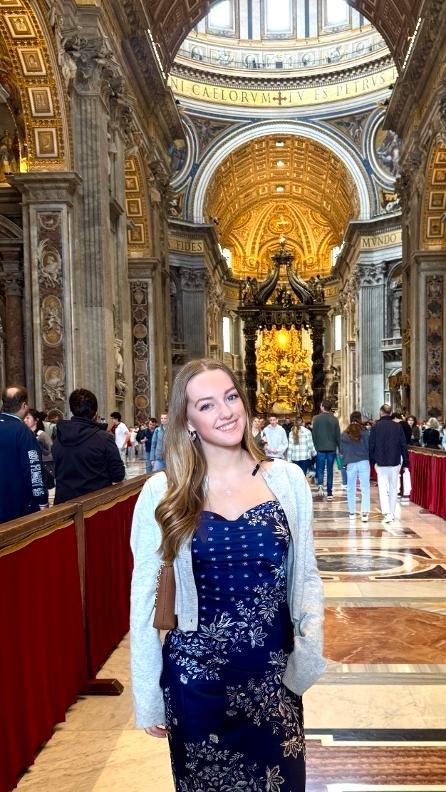
Catholics for Courage (C4C) began with a simple revelation while sitting in the back of a high school AP Geography classroom. Learning about the inequalities that shape communities around the world, I found myself thinking about my own Catholic faith — reflecting closely on its teachings about the importance of education and our responsibility to serve others.
I began to wonder what it would look like to turn those values into something tangible. Education is something I have the privilege of receiving every day, yet millions of people around the world are denied that same opportunity simply because of the circumstances into which they were born. I came to believe that education can do more than provide knowledge — it can break cycles of generational poverty and open doors to a different future. I didn't want to simply learn about those realities and move on. I wanted to do something.
This singular "What if?" question is what matured and eventually became the beginning of Catholics for Courage.
I founded Catholics for Courage with the hope of putting Catholic values into action by helping create greater opportunities for those who need them most. At its heart, C4C is about recognizing the God-given dignity and potential of each individual — and investing in people, not simply the problems they face. I believe that tomorrow's leaders need more than a credential; they need an ethical foundation rooted in character, responsibility, and service.
I am still a student, a human, and most importantly, still learning. But I have come to believe that you don't have to wait until you're older, more experienced, or more accomplished to begin serving others. Sometimes all it takes is recognizing a need, caring enough to act, and having the courage to start.
That is what Catholics for Courage means to me.
 Catholics for Courage